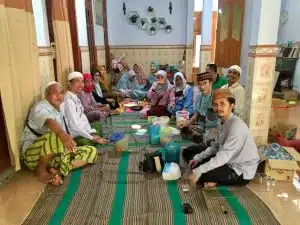
The tenth post in our Celebrating Alumni profile series is Dr Aan Rukmana, a 2007 AIMEP alumnus, Islamic philosophy lecturer at Universitas Paramadina, and the founder of Sekolah Islam Elmadani Holistika, Sekolah Alam Kebun Tumbuh, and Bahagia Institute.
Read Aan’s story below:
Aan Rukmana
I grew up in Kuningan, a village in West Java, and ever since I was a child, like most village children, I dreamt of living, studying and working in a city. My parents ran a small restaurant and they were able to send me to a modern Islamic pesantren (boarding school) in Banten province.
After graduating, I taught there for a year before entering university. I was awarded a scholarship to study for a Bachelor’s degree in philosophy and religion at Paramadina University in Jakarta.

At first, I did not find philosophy interesting, and I couldn’t see what it would lead to after graduation. On the other hand, my friend who was studying Management found it easy to tell everyone that after graduating he would be a manager or a businessman!
However, when I started to take the course seriously, I read many books on both Western and Islamic philosophy, and the topic started to engage me. I also improved my English, and became involved in many student activities. As a result, one of the professors asked me to help with a new program called the Australia Indonesia Muslim Exchange Program (AIMEP). I was to act as guide for an Australian delegation.

The five delegates spent about two weeks in Indonesia. I took them to various Islamic organisations in Jakarta, such as Muhammadiyah and Nahdlatul Ulama. We visited Taman Mini (a miniature theme park of Indonesia), and I also took them to various pesantren. I did my best to explain the Indonesian way of life to them and tried to be as helpful as I could. At the time my English was poor, and it was difficult for me to understand the Australians at first because they spoke very quickly. However, alhamdulillah, I quickly improved!
The following year I was accepted to go to Australia on the same program. This was my first trip outside Indonesia, and it really changed my life. I began to appreciate the beauty of other countries, and to gain insight into the nature of global citizenship and international relations. And since this was a leadership program, I also began to understand the nature of true leadership.

In Australia, I came into contact with both Islamic and non-Islamic organisations which aimed at helping migrants, particularly encouraging them to continue their education. This experience was formative for me, and made me dream of one day starting my own school in Indonesia. Of course, for some years this was only a dream because at that point I was only twenty-five years old!
Being a part of the AIMEP really opened doors for me, because after that I was able to access a range of scholarships.
First, I gained a scholarship to spend six months in Iran, studying hermeneutics and critical thinking in Islamic philosophy. Next, I had the opportunity to spend six months at the Vatican. I lived in a dormitory in the Holy See, and the head of the dormitory helped me to understand a lot about Catholicism and its relationship to Islam, which really opened up my mind and my heart to see the relationship between the different faiths. I was even privileged to take part in an audience with Pope Benedict XVI. He reminded us that we have to protect the world, and that we are all members of one family, even though we have differences. This has been an important idea for me ever since that time.

I next received a scholarship from the British Embassy which enabled me to travel to the Philippines, Malaysia, and Thailand, to learn about leadership. Finally, I spent two months at La Trobe University in Melbourne where I continued to study Muslim ideas about leadership.
When I finally settled back in Indonesia, I started working as a philosophy lecturer at Paramadina University. However, I had not forgotten my dream of establishing a school, even though I was still only about twenty-nine at that time.

First, I got in contact with a friend I had made in Australia who was one of the architects of the Islamic Museum in Melbourne. He came to Indonesia and showed me many ideas about the school’s possible design. I wanted it to be a ‘nature school’, where we encourage students to love nature and to study in the open air, and where we implement the philosophy of nature into our curriculum.
I also thought about what kind of educational philosophy the school would have, and I decided on four pillars. The first is ethics, where we teach the students the importance of respect and love for other people. The second is leadership. The third is critical and creative thinking. And the fourth is entrepreneurship. For example, we have a market day, when each student will prepare something that they can sell.

Finally, I recruited a principal and teachers. Alhamdulillah, because of the leadership programs I’d been involved in, I knew how to be a good leader. I also started publicising the school to future students.
Sekolah Alam Kebun Tumbuh has now been operating for about twelve years, and currently we have about 300 students, from kindergarten to middle school. Originally, as I come from a poor background myself, I intended the school to be aimed at poor students, to try to provide them with the kind of opportunities I’d had. However, as the population around the school has continued to increase, more prosperous families around the school have started to enrol their children there as well. As a result, the school is now self-supporting.

As the founder of the school, I go there once or twice a week to make sure that it is running well. But I still work as a philosophy lecturer, and I am also the author of about ten books on religion and philosophy. Another role I have is in an advisory capacity for my old secondary school, which is also a pesantren.
I want young Indonesians to understand that we can’t go on living in the limited mindset of the very conservative attitude. I believe we have to open our minds and be ready to not only respect other people, but also to collaborate with them.

Aan Rukmana
Jakarta, Indonesia
AIMEP 2007